HVAC • Cooling Performance
If your AC keeps running, start by checking whether your home is staying comfortable. Long operation during hot weather can be expected. However, continuous operation with rising indoor temperatures deserves investigation.
The key is to identify what is running: the indoor fan, the cooling equipment, or a variable-speed system maintaining temperature at reduced output.
Long runtime alone does not prove a fault. Check the equipment type, thermostat settings, and indoor temperature trend. A sudden change, poor cooling, visible ice, or equipment that ignores the thermostat’s OFF command calls for professional attention.
When Long AC Runtime Can Be Normal
Hot weather increases cooling demand
Air conditioners can run longer during the hottest part of the day. Consider whether the home holds its usual temperature and whether operation changes as outdoor conditions ease.
A new pattern on a mild day is more useful information than comparing your equipment with a neighbor’s system. Record the weather and thermostat settings before assuming a failure.
Variable-speed equipment operates differently
A single-stage compressor generally switches between full output and off. In contrast, variable-speed equipment adjusts its output to match cooling demand.
Carrier explains that these systems can operate longer at lower speeds. Two-stage equipment also has a lower-output operating mode. Therefore, frequent quiet operation may reflect the system’s design.
Check your model information or ask the installer what operation to expect. Runtime should be assessed alongside comfort and equipment behavior, rather than against one universal cycle length.
What It Means When Your AC Keeps Running
| Pattern | Possible explanation | Useful next step |
|---|---|---|
| Quiet operation with steady comfort | Variable-speed or low-stage operation | Confirm the equipment type |
| Airflow continues between cooling calls | Fan ON or circulation setting | Review thermostat fan settings |
| Long operation with weak airflow | Filter restriction or other airflow problem | Check accessible filter and vents |
| Cooling continues but the house gets warmer | Performance or cooling-load problem | Arrange an assessment |
| Outdoor equipment ignores OFF | Possible control or electrical fault | Call an HVAC professional |
Simple Checks Before Booking Service
Review the thermostat and fan settings
Confirm the cooling setpoint and check for scheduled changes. Also look at the fan setting. ON can keep the indoor blower operating between cooling calls; AUTO generally ties airflow to system operation.
Some thermostats also offer circulation schedules. Consult the manual before treating continued airflow as a malfunction.
Inspect the accessible filter and vents
Following your equipment’s shutdown instructions, check an accessible filter and replace it if needed with the specified type and size. Move furniture away from return grilles and supply registers.
These observations do not require opening equipment cabinets. If airflow remains weak, ask a technician to investigate.
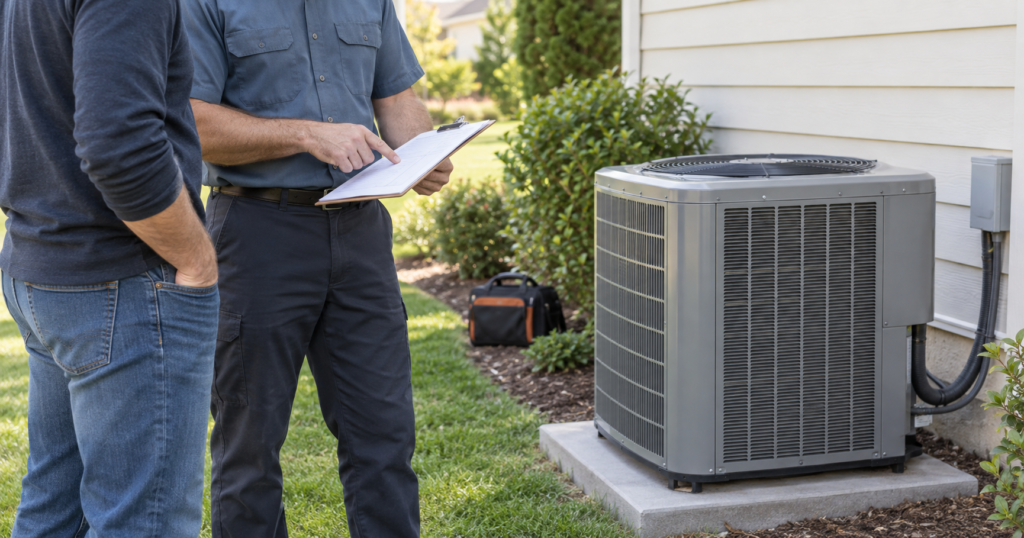
Look around the outdoor unit
Check whether plants or loose debris crowd the condenser. Follow the manufacturer’s clearance guidance and avoid reaching through the grille.
Dirty outdoor coils can reduce performance. Leave internal cleaning to a professional, and do not use a pressure washer on the fins. Our HVAC maintenance cost guide helps you plan routine care.
Keep a short observation log: Note the time, indoor temperature, setpoint, outdoor conditions, and any alerts. Record what you changed so the technician can distinguish the original problem from later adjustments.
Problems That Need Professional Diagnosis
Frozen coils or refrigerant problems
Ice can interfere with cooling even while parts of the system continue running. Trane identifies restricted airflow and low refrigerant among the possible causes of a frozen evaporator.
If you see ice on refrigerant tubing or the equipment, turn cooling off and arrange service. Do not chip the ice or assume thawing has repaired the underlying problem.
For a system that runs without delivering cool air, see why your AC is running but not cooling.
Controls fail to stop the equipment
An outdoor unit that continues operating after cooling is switched off deserves prompt attention. A stuck electrical contactor is one possible cause, but testing is necessary.
A brief indoor fan delay may be normal for some equipment. Report which component continues running rather than saying only that “the AC is on.”
Do not open electrical compartments or pull thermostat wires. If the system ignores OFF, contact a professional for shutdown guidance. Report burning smells, unusual noise, or visible ice immediately.
The equipment and home need a broader assessment
Persistent comfort problems may require checking capacity, duct performance, and the building’s cooling demand. Ask whether the issue involves the equipment itself or conditions elsewhere in the home.
Before approving a larger unit, request a cooling-load assessment. Carrier emphasizes proper sizing, airflow, duct inspection, and refrigerant charge as parts of a successful installation.
What to Ask During the Service Visit
If your AC keeps running differently from its usual pattern, bring your observations to the appointment. Ask for a diagnosis that explains the behavior before discussing replacement.
- Operating mode: Is the observed runtime expected for this model?
- Confirmed problem: What testing identifies the fault?
- Repair scope: Which work will correct it?
- Price: What are the diagnostic, labor, and parts charges?
- Follow-up: What operation should you expect afterward?
For budgeting, review our HVAC repair cost guide. A runtime complaint alone cannot establish the repair price.
Routine observation
You know the equipment type, comfort remains steady, and the operating pattern matches what the installer explained.
Service assessment
Operation changed suddenly, comfort declined, or the equipment no longer responds normally to its controls.
If a major repair is proposed, our AC repair versus replacement guide explains how to compare options. Long runtime by itself is not a reason to replace an otherwise functioning system.
Frequently Asked Questions
How many minutes should an AC run per cycle?
There is no single cycle length that fits every system and condition. Compressor type, weather, and cooling demand affect operation. Ask what is normal for your model.
Does longer runtime always mean a higher bill?
Not necessarily when comparing different operating speeds or systems. Variable-speed equipment can run longer at reduced output. Compare electricity use and operating conditions rather than runtime alone.
Why does the fan run after cooling stops?
A fan setting, circulation schedule, or programmed delay may explain it. Check the manual. If the behavior is new or ignores the controls, arrange service.
Should I repeatedly switch the AC off to give it a break?
Do not use repeated restarts to manage an unexplained problem. Identify whether operation is normal for the equipment or needs diagnosis.
Sources and Editorial Method
This guide distinguishes equipment operating modes from faults using manufacturer resources. The observation checklist helps homeowners describe a problem; it does not diagnose individual equipment.