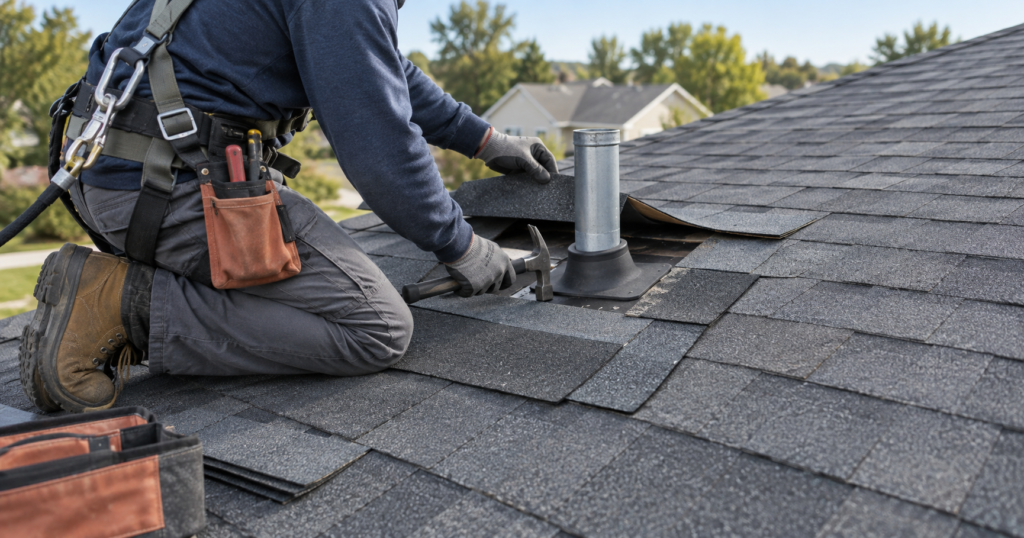
DIY roof repair can appear cheaper because you avoid paying contractor labor. However, the real comparison includes diagnosis, access equipment, materials, your time and the consequences of an unsuccessful repair.
For most homeowners, documenting symptoms and arranging an assessment are practical starting points. Work involving roof access, flashing or hidden damage usually calls for professional experience.
DIY Roof Repair vs Professional Repair
The difference extends beyond who performs the labor. A reliable repair requires identifying the source and integrating new materials with the existing roof.
| Factor | DIY approach | Professional approach |
|---|---|---|
| Initial spending | Materials and any equipment you need | Labor, materials and the agreed service scope |
| Diagnosis | Depends on your experience | Should include an explanation of the defect |
| Access and safety | You must assess and manage the hazards | Contractor should plan appropriate access and protection |
| Material compatibility | You must identify suitable products and methods | Roofer should understand the specific roofing system |
| Unexpected damage | May exceed your skills or available equipment | Should be documented and addressed through an agreed process |
| Workmanship support | No separate contractor workmanship commitment | Coverage depends on the written agreement |
Hiring a contractor does not automatically guarantee quality. Therefore, experience, documentation and a clear repair scope remain important.
What Does DIY Roof Repair Actually Cost?
Materials are only one part
A tube of sealant or replacement shingle may look inexpensive. However, the job may also require compatible flashing, underlayment, fasteners and replacement materials for surrounding areas.
Additionally, you may need tools and suitable access equipment. Do not compare a materials-only shopping list with a contractor quote for complete work.
Your time and uncertainty matter
Diagnosis, product selection, preparation and cleanup all take time. Meanwhile, an incorrect repair can allow water to continue reaching concealed materials.
For that reason, calculate the cost of a complete outcome. Include any professional assessment or corrective work you might still need.
A hypothetical comparison
Suppose a homeowner budgets $150 for materials and receives a $700 professional quote. These figures are illustrative, not typical prices or a savings estimate.
The apparent difference is $550. However, that comparison excludes tools, time, access requirements and whether both approaches correct the same defect.
For broader planning, review our roof repair cost guide and request a property-specific quote.
Useful Tasks Homeowners Can Handle
Document symptoms from a safe location
Record when a leak appears and whether wind or heavy rain accompanies it. Also, photograph visible stains without standing beneath an unstable ceiling.
This information helps a roofer investigate the source. Our guide to common roof leak causes explains potential entry points.
Review installation and repair records
Collect invoices, product information and previous inspection reports. These records may identify the roofing material and earlier problem areas.
Additionally, provide any relevant warranty documents to the contractor before alterations begin.
Observe the roof from the ground
From a safe position, note missing materials, visible debris and unusual changes. However, a ground-level view cannot establish the condition of concealed details.
Do not climb onto the roof simply to confirm what you photographed. Instead, share the observations during the assessment.
When Professional Roof Repair Makes Sense
The work requires roof access
Height, slope, weather and surface condition all affect access. Even a low roof can present a serious fall hazard.
OSHA’s construction fall-prevention campaign emphasizes planning, appropriate equipment and training. Its guidance concerns worker safety; owning equipment alone does not establish competence.
Learn more about that framework through OSHA’s fall-prevention campaign.
The source of a leak is unclear
Water can travel before reaching a ceiling stain. Consequently, applying a patch directly above the stain may miss the exterior opening.
An assessment should connect the interior evidence to a plausible source. See our roof inspection cost guide for inspection options.
Flashing or roof penetrations need work
Chimneys, walls and vents require details that direct water correctly. Surface sealant may not correct an improperly assembled connection.
For examples, read our chimney flashing repair guide and roof vent replacement guide.
Decking or framing may be damaged
Soft decking, new sagging or extensive moisture can indicate work beyond the covering. A contractor should determine whether structural expertise is also needed.
Our roof decking replacement cost guide explains this additional repair scope.
The roofing material requires specialized methods
Tile, slate, metal and membrane roofs have different repair requirements. Furthermore, unsuitable foot traffic or incompatible products can create additional damage.
Choose a contractor with experience in your specific system. General construction experience does not necessarily establish roofing expertise.
Common DIY Roof Repair Mistakes
Treating sealant as a universal solution
Sealant has appropriate uses, but it cannot replace every flashing or installation detail. First, determine why water is entering.
Otherwise, a visible patch may conceal a defect while leaving the water path intact.
Using an incompatible product
A repair product suitable for one material may be inappropriate for another. Therefore, confirm compatibility and application requirements before any work.
Also, consider existing coatings and prior repairs. Their presence can affect whether a new product will adhere or perform as intended.
Ignoring damage below the surface
Stopping the drip does not automatically dry insulation or restore damaged decking. Consequently, the interior and underlying materials may need separate assessment.
Our roof leak repair cost guide explains why the full scope can exceed a small exterior patch.
Attempting repairs during a storm
Wind, rain and damaged surfaces can make access unsafe. Do not attempt exterior roof work while those hazards are present.
If water is entering now, use our roof leak emergency guide to identify the appropriate response.
Will DIY Work Affect a Roofing Warranty?
Check the actual warranty before altering the roof. Product coverage and workmanship coverage are separate, and their conditions vary.
Do not assume every homeowner repair automatically voids all coverage. Equally, do not assume a repair method is acceptable without checking the written requirements.
When uncertain, ask the manufacturer or installer for written clarification about the proposed work.
How to Compare Professional Repair Quotes
Start with a diagnosis and a defined scope. Then compare what each contractor will correct, restore and leave outside the job.
- Ask for photographs of the identified defect.
- Confirm experience with your roofing material.
- Request the repair method and materials in writing.
- Check applicable licensing and insurance documentation.
- Ask how hidden damage will be approved and priced.
- Clarify cleanup, follow-up and workmanship terms.
Also, ask whether the repair is intended as temporary protection or a permanent correction. Those outcomes should not be treated as equivalent.
DIY Roof Repair FAQs
Is DIY roof repair always cheaper?
No. Materials may cost less than a professional service, but equipment, time and corrective work can change the total. Compare equivalent outcomes.
Can I replace one shingle myself?
The visible task may be small, but access and integration with surrounding shingles still matter. Homeowners without roofing experience should use a qualified roofer.
Can sealant permanently stop a roof leak?
It may be appropriate for certain details. However, its suitability depends on the defect, product and roofing system. Diagnosis should come first.
Can a professional repair fail?
Yes. Incorrect diagnosis or workmanship can leave a problem unresolved. Request documentation, a clear scope and written follow-up terms.
What is the most useful thing I can do before a roofer arrives?
Document symptoms safely and gather previous repair records. Share when leaks occur and any recent changes, without accessing the roof.
Editorial Approach
This comparison focuses on scope, diagnosis, access and repair quality. The numerical example is hypothetical and does not represent a market average.
OSHA’s fall-prevention framework is referenced for professional construction safety context. This article is not a roof-access or repair procedure.