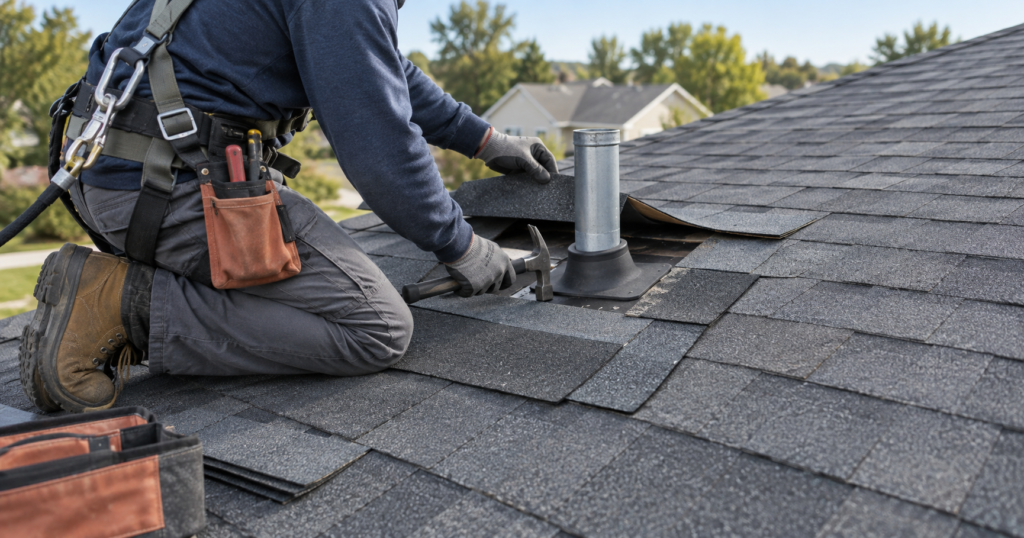
Common roof leak causes include damaged flashing, failed pipe boots, missing shingles and defective roof seams. However, water on a ceiling can also come from plumbing or condensation.
Start by identifying when the moisture appears. Rainfall, wind direction and equipment use can provide useful clues, although none establishes the source by itself.
Eight Common Roof Leak Causes
Roof leaks often involve intersections and penetrations as well as the covering itself. Therefore, shingles that look intact from the ground do not rule out a roofing problem.
1. Damaged or incorrectly installed flashing
Flashing directs water away from joints around chimneys, walls and other intersections. Gaps, corrosion or incorrect installation can allow water behind these protective details.
As a result, a localized flashing problem may cause a leak even when nearby shingles remain sound. Applying surface sealant alone may leave the underlying defect unresolved.
For chimney-related work, see our chimney flashing repair cost guide.
2. Cracked plumbing vent boots
A plumbing vent boot seals the area where a pipe passes through the roof. Its collar or flashing can deteriorate and allow water around the pipe.
However, a plumbing vent boot serves a different purpose from an attic exhaust vent. Ask the contractor to identify the exact component in the estimate.
3. Missing, cracked or displaced shingles
Wind, falling debris and material deterioration can damage asphalt shingles. This damage may expose underlying layers to more water than they were intended to handle.
Nevertheless, missing shingles do not always produce an immediate indoor drip. Underlayment and the location of the opening can affect when moisture becomes visible.
Our roof repair cost guide explains common repair categories.
4. Defective skylight details
Water near a skylight can originate from its flashing, seals or surrounding roofing. Additionally, condensation on the interior surface can resemble a leak.
Therefore, replacing the skylight is not automatically the correct solution. The inspection should establish whether the problem involves the unit or its connection to the roof.
5. Damaged roof vents
A cracked vent housing or defective surrounding flashing can create an entry point. Wind-driven rain may also expose problems that remain unnoticed during lighter rainfall.
However, replacing a vent will not correct unrelated damage in the adjacent roof. Request an assessment of both the component and its installation.
See our roof vent replacement cost guide for planning information.
6. Valley damage or debris buildup
Valleys channel water where roof slopes meet. Consequently, damaged valley materials or debris that disrupts drainage deserve attention.
Leaves and branches can also conceal defects. A professional should inspect the underlying surface rather than assume debris removal will resolve every leak.
7. Water backup at roof edges
Blocked gutters can contribute to overflow and wet roof-edge components. However, whether water enters the home depends on the surrounding construction and defects.
In freezing conditions, ice dams can hold water near the eaves. Backed-up water may then move beneath roofing materials.
Do not climb onto an icy roof or chip ice from the covering. Ask a qualified professional to address both the immediate condition and its contributing causes.
8. Failed seams or damaged low-slope roofing
Membrane roofs can develop punctures or failures at seams and penetrations. Standing water may expose these weak points, although ponding alone does not identify the leak source.
Also, the repair must suit the specific membrane. A material that works on one roofing system may be incompatible with another.
Roof Leak Causes by Timing and Location
Timing helps narrow the investigation. However, these observations are clues rather than proof, because moisture can travel or remain trapped before appearing indoors.
| Observation | Possible explanation | What to record |
|---|---|---|
| Leak during heavy rain | A defect exposed by greater water flow | Rain intensity and time until dripping starts |
| Leak during windy rain | Water entering an exposed joint or penetration | Wind direction and affected room |
| Moisture after snowmelt | Water backup or another roof defect | Ice near eaves and outdoor conditions |
| Dripping without recent rain | Plumbing, HVAC moisture or stored water | Equipment use and nearby plumbing fixtures |
| Moisture near a chimney | Flashing or another chimney-related defect | Stain position and weather conditions |
| Widespread attic droplets | Possible condensation | Temperature changes and visible moisture patterns |
Could the Water Come From Somewhere Else?
Attic condensation
Warm, moist indoor air can reach colder attic surfaces and condense. In some homes, this produces wet sheathing or droplets that resemble rain leakage.
Consequently, the assessment may need to consider indoor moisture, air leakage and ventilation. Adding roof vents without identifying the cause may not resolve the problem.
Plumbing or HVAC moisture
A pipe above the ceiling can leak independently of rainfall. Likewise, an HVAC condensate problem may create moisture when the equipment operates.
If symptoms follow showers, laundry or cooling cycles, share that pattern with the professional. A plumber or HVAC technician may be needed alongside a roofer.
Water traveling from another location
The stain directly above your sofa may not sit beneath the exterior opening. Water can move along framing or other surfaces before becoming visible.
For that reason, repairing the roof directly above a stain without tracing the path may miss the source.
What to Do When Your Roof Starts Leaking
Keep clear of dangerous areas
First, stay away from sagging ceilings and areas where water reaches electrical fixtures. Do not touch wet switches, wiring or equipment.
If the ceiling bulges or structural movement appears, keep people out of the affected area and seek urgent professional assistance.
Limit damage where it is safe
Next, move belongings away from a minor drip if you can do so safely. Place a container beneath it only when the ceiling above appears stable.
Take photographs and note the time. However, avoid entering an unsafe attic or climbing onto a wet roof to investigate.
Arrange assessment and temporary protection
Contact a roofing professional and describe the symptoms. Ask whether temporary exterior protection is needed before a permanent repair can be completed.
Also, have wet building materials assessed for drying or removal. Stopping water entry does not automatically dry concealed insulation or finishes.
How a Professional Investigates Roof Leak Causes
A useful investigation connects the interior moisture pattern to a plausible entry point. Depending on access, it may include exterior observations and an attic assessment.
The roofer may examine flashing, penetrations, nearby coverings and evidence of previous repairs. However, concealed areas can limit what a visual inspection establishes.
- Ask for photographs of the suspected defect.
- Request an explanation of the likely water path.
- Confirm which areas could not be inspected.
- Ask whether additional testing is necessary.
- Get the proposed repair scope in writing.
For inspection options, read our roof inspection cost guide.
Does a Roof Leak Mean You Need Replacement?
No. A single failed boot or flashing detail may qualify for a targeted repair when the surrounding roof remains sound.
However, widespread deterioration or extensive hidden damage may justify broader work. Compare the findings using our roof repair vs replacement guide.
Before approving work, confirm whether the quote includes damaged decking, interior repairs and drying. These items may require separate estimates.
Frequently Asked Questions
Why is my roof leaking when the shingles look fine?
The problem may involve flashing, a vent boot, a skylight or another concealed detail. Shingle appearance alone cannot rule out a roof leak.
Why does the roof leak only during heavy rain?
Heavy rainfall may expose defects that do not admit noticeable water during lighter showers. However, the exact source still needs investigation.
Can a new roof leak?
Yes. Installation defects, damaged components or problems at adjoining walls can cause leaks on a new roof. Contact the installer and document the symptoms.
Will the ceiling stain disappear once the roof is fixed?
Usually, the existing stain remains until the finish is restored. First, confirm the leak is resolved and affected materials are adequately dry.
Can I wait until the next rain to investigate?
Arrange an assessment promptly rather than relying on another storm. Even when dripping stops, moisture may remain within concealed materials.
Editorial Approach
This guide describes possible causes and observations to share with a professional. Symptoms alone cannot establish the source of an individual leak.
Repair decisions should follow an assessment of the affected roof and interior materials.