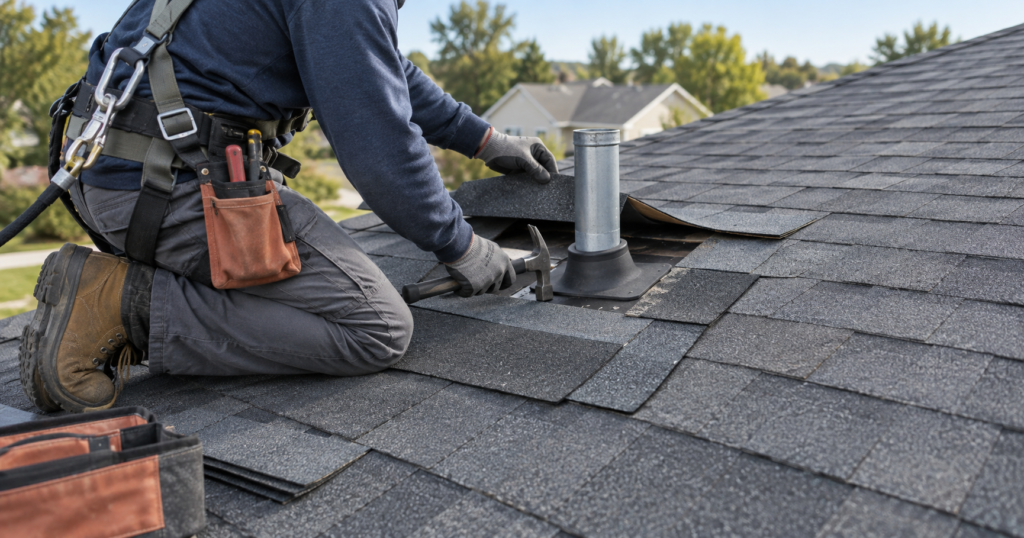
Roof repair vs replacement comes down to the extent of damage, the condition of surrounding materials and the value of the proposed work. A localized defect may need only a repair. However, widespread deterioration can make replacement the more practical choice.
Before comparing prices, establish what caused the problem. Otherwise, you could pay for a repair that misses the source or replace a serviceable roof unnecessarily.
Roof Repair vs Replacement at a Glance
Compare the condition of the entire system, not just the most visible symptom. For example, a ceiling stain can result from one flashing defect.
| Factor | Repair may fit | Replacement may fit |
|---|---|---|
| Damage | One localized area or component | Deterioration across several roof sections |
| Surrounding materials | Sound and suitable for integrating repairs | Brittle, damaged or difficult to repair reliably |
| Leak history | An identifiable, isolated source | Multiple failures alongside broader deterioration |
| Remaining service life | Inspection supports continued use | Condition suggests limited useful life |
| Initial expense | Usually lower for a limited scope | Usually higher because more materials are renewed |
| Work involved | Targeted removal and restoration | Broader removal, installation and cleanup |
These are decision factors, not automatic rules. If findings are unclear, review our roof inspection cost guide before seeking a second assessment.
When Roof Repair Makes Sense
The damage is isolated
A limited section of missing shingles may be repairable when adjacent shingles remain sound. Similarly, a damaged roof vent may need replacement without disturbing the entire roof.
However, the contractor must check for damage beneath the visible defect. A small opening can allow water to affect decking and nearby materials.
For component-specific work, see our roof vent replacement cost guide.
The leak has a clear source
A leak around a chimney or wall intersection may come from flashing rather than widespread roof failure. Therefore, correcting that detail may restore protection.
Ask the roofer to explain the water-entry point and proposed repair. Repeatedly applying sealant without diagnosing the source may leave the underlying problem unresolved.
Our chimney flashing repair guide explains one common source of localized leaks.
The remaining roof is serviceable
A repair offers more value when the surrounding roof can continue performing after the work. Nevertheless, a recent installation does not guarantee good condition.
Poor workmanship or storm damage can affect a relatively young roof. Conversely, an older roof may remain serviceable with appropriate maintenance.
When Roof Replacement Deserves Consideration
Deterioration affects multiple areas
Widespread cracking, curling or material failure can make individual repairs difficult to justify. Additionally, repairing one section may leave similar problems elsewhere.
Have the contractor photograph the affected areas. This evidence helps distinguish broad deterioration from a recommendation based only on roof age.
See our guide to signs you need a new roof for conditions worth checking.
Repairs cannot integrate reliably
Older asphalt shingles can become too brittle to lift without breaking. As a result, replacing a small section may damage the surrounding covering.
Material compatibility matters as well. However, a color mismatch alone does not establish that full replacement is technically necessary.
Underlying damage requires extensive removal
Damaged decking may require removing the covering above it. If deterioration extends across a large area, replacement becomes a more relevant option.
However, replacing the covering does not automatically resolve structural problems. The estimate should identify decking repairs and any framing work separately.
Our roof decking replacement cost guide explains this additional scope.
Recurring failures accompany an aging system
Several unrelated leaks can indicate that different components are reaching the end of their service lives. In that situation, repeated repairs may provide limited benefit.
Still, a recurring leak at one location may simply reflect an incorrect earlier diagnosis. Therefore, establish the cause before assuming the whole roof has failed.
How to Compare Roof Repair vs Replacement Costs
Start with written quotes for your property. National ranges cannot account for every roof size, access difficulty, material or hidden defect.
Use our roof repair cost guide and roof replacement cost guide for background. Then compare the work each contractor actually proposes.
Compare equivalent work
A repair quote should identify the cause being corrected and the materials being restored. Meanwhile, a replacement quote should specify removal, underlayment, flashing and ventilation work.
Also, confirm disposal charges, access costs and how hidden damage will be priced. Otherwise, an apparently cheaper quote may exclude necessary items.
Consider what the repair accomplishes
A useful repair restores a specific function and supports continued use of the surrounding roof. It should have a clear purpose beyond postponing an unresolved problem.
Ask how much confidence the contractor has in continued service. However, treat remaining-life estimates as professional judgments rather than promises.
A simple quote comparison example
Suppose you receive a $1,200 repair quote and a $14,000 replacement quote. These are hypothetical figures, not national pricing estimates.
The repair equals approximately 8.6% of the replacement price. Nevertheless, that percentage alone cannot tell you which option is better.
If the repair corrects an isolated defect on a sound roof, it may be sensible. If it leaves widespread deterioration unresolved, its value changes substantially.
How Much Should Roof Age Influence the Decision?
Age helps frame the inspection, but it should not decide the outcome alone. Material, installation and exposure all affect service life.
For example, the same age can mean different things for asphalt shingles and natural slate. Read our guide to how long a roof lasts for material-specific context.
In addition, roof coverings and accessories may age at different rates. A failed pipe boot does not necessarily mean the surrounding shingles need replacement.
Can You Replace Only Part of a Roof?
Replacing one slope or a separate roof section may be possible. However, the contractor must explain how the new work connects to existing valleys, ridges and flashing.
A partial replacement can also leave sections with different maintenance timelines. Therefore, compare its total scope with both targeted repair and complete replacement.
What about installing shingles over the old roof?
An overlay retains the existing covering beneath a new layer. It is a different scope from removing the old roof before installation.
Before considering it, ask the contractor to confirm applicable requirements and whether the existing assembly is suitable. Covering old materials also limits access to hidden defects.
Consequently, compare overlay and tear-off proposals separately. A lower price does not mean both approaches provide the same investigation or preparation.
Questions to Ask Before Choosing
- What caused the damage, and where is the evidence?
- Which defects are isolated and which are widespread?
- Can the existing materials support a reliable repair?
- What problems would remain after the proposed work?
- Does the quote include flashing and underlayment work?
- How will hidden decking damage be documented and priced?
- What workmanship coverage applies to this exact scope?
- Would a separate inspection help resolve uncertainty?
When recommendations conflict, ask each contractor to address the same photographs and findings. This makes the comparison more useful than simply collecting different total prices.
What If the Roof Is Leaking Now?
An active leak needs prompt attention even while you compare long-term options. Ask a professional whether temporary protection or immediate repair is needed.
However, temporary protection is not a final diagnosis. Continue the assessment once the immediate water-entry problem is controlled.
Our roof leak repair cost guide provides additional context for the repair process.
Roof Repair vs Replacement FAQs
Is repairing a roof always cheaper?
A limited repair usually costs less initially. However, extensive repairs can involve substantial labor and may leave other aging components that still need attention.
Does a roof leak mean I need replacement?
No. A leak may come from one flashing detail or damaged component. First, establish the source and inspect the surrounding materials.
Should I replace a roof before selling my home?
Base the decision on documented condition and the proposed work. A sale does not automatically make replacement necessary or guarantee recovery of its cost.
Can a repair extend my roof’s useful life?
A repair can correct a localized defect and prevent further damage. However, it cannot reverse deterioration across the remaining roof.
What if two roofers recommend different solutions?
Request written explanations and photographs from both. If the disagreement remains significant, an independent inspection may help clarify the appropriate scope.
How to Use This Comparison
This guide provides a framework for reviewing inspection findings and contractor proposals. It does not establish a universal replacement age or repair-cost threshold.
The numerical example is illustrative. Use property-specific quotes and documented roof conditions for your decision.